Animated scale charts
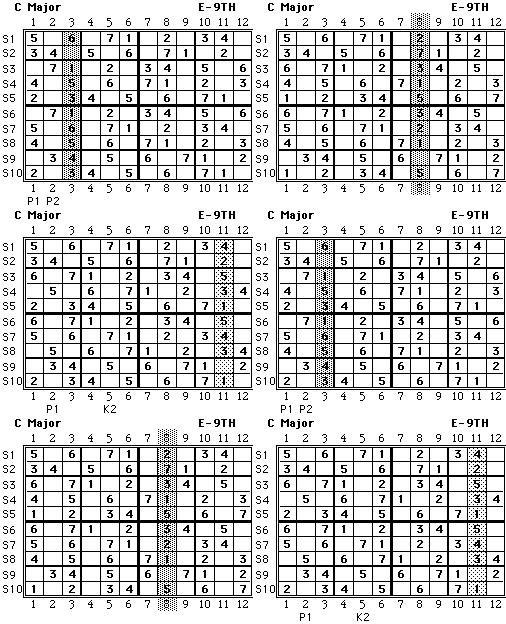
Pedal terminology
C scale changes The chart is the pattern that a C scale creates on a standard E9th
steel guitar. Notice how it changes when you press pedals and knee levers.
I study each of the combinations as a new tuning. I use to do everything
with no pedals as a starting position, but the Universal tuning that
I use got me to thinking as each combination as a possible new tuning
that creates a pattern. Expanding my horizons as to what was taking place musically when I
pushed the pedals helped my playing. If your hands are in great shape
and can make the necessary moves then you need to know where to apply
them. With my charts I can see how the music lays upon my steel. I learned
faster when I could see it on paper and then relate that to my hands.
Trying to learn it by ear left a lot to be desired. Working on everything
that I could to make me a better player I came up with different ways
of studying and improving my abilities as a pedal steel guitarist. The above animation was done using Gifbuilder and the screens were
created with an Excel spreadsheet. I trained my hands to know basic
moves that can be used on any steel guitar. Whether its a lap, dobro,
triple neck, or pedal steel, I could apply my basic theories of movement
to all tunings. All used a slide and the strings were picked with a
thumb and three fingers. At first I only worried about the C major scale.
When I got to the point of memorizing that pattern, I then could apply
what each pedal and knee would do to my pattern. As I got better at reading my charts, I started studying scales. When
I got done there were 53 different ones I had accumulated in my travels.
Each creates a unique pattern upon the fretboard. I wrote a program
in Applesoft Basic that drew these patterns on the screen. That got
me to thinking about the possibilities. I came up with the above charts
and printed them out as scale books. I spent time studying the charts and working on memorizing some of the patterns. Concentrating on the key of C allowed me to learn more and the trick was to know that you could transpose it to the other twelve keys. It was a fun process and I learned a lot from studying and writing all of the books and charts. Where it helped me most was when I got in a live situation and my hands knew the patterns without thinking. I could go on auto pilot and play like myself. And that's what I wanted when I first started studying the steel. To be able to improvise in all situations. Remember, the numbers 1 thru 7 represent the C major scale tones. Scale tones
|
|||||||

